How to Get a Thai SIM Card in Bangkok: The 2026 Arrival Guide
Get your Thai SIM card in Bangkok in 10 minutes. Airport vs 7-Eleven, AIS vs dtac vs TrueMove H, eSIM options, and the carrier to pick for your neighborhood.
You step out of immigration at Suvarnabhumi, follow the green arrows, and the moment you reach the arrivals hall the airport pulls you into its first decision. Between gates 5 and 7 sits a row of glass-fronted kiosks branded AIS, dtac, and TrueMove H, each staffed by an agent waving a small plastic SIM packet. Getting a Thai SIM card in Bangkok is the first practical move of any trip or move-in, and the choice you make at this counter sets your connectivity for the next week or the next year.
This guide walks through the three Thai carriers, what their tourist SIMs actually include, where to buy off-airport for the same price, eSIM alternatives that skip the queue, and the long-term postpaid options if Bangkok is now home. By the end you will know which SIM to pick for Sukhumvit, for Phra Nakhon, and for trips down to the islands.
The Three Carriers: AIS, dtac, TrueMove H
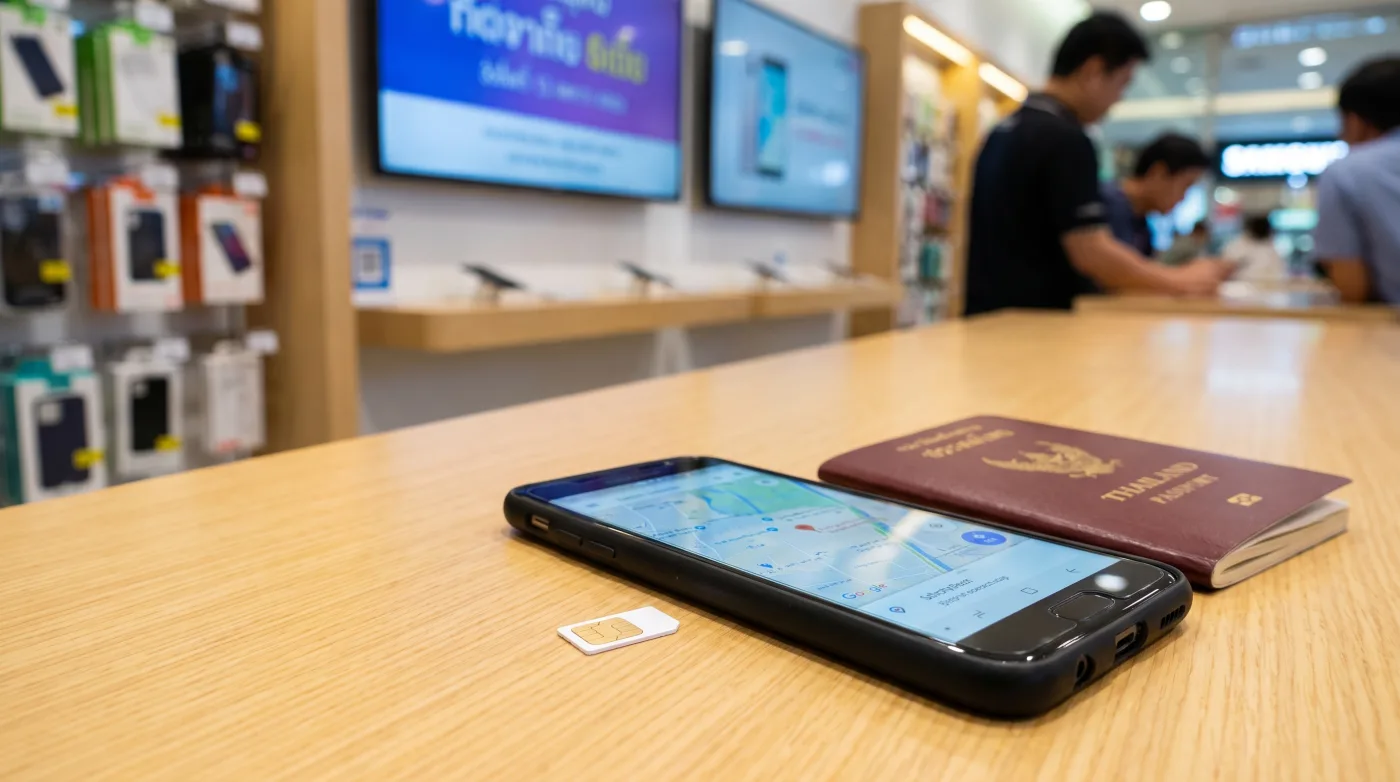
Three carriers, near-identical tourist plans. Passport out, SIM in, done in minutes.
Thailand runs on three mobile networks, and all three are genuinely competitive in Bangkok.
AIS is the largest by subscriber base and runs the deepest 5G footprint across the city. Indoor coverage in malls, hotels, and high-rise condos is usually the strongest on AIS, which matters in Sukhumvit and Sathorn where signal has to punch through a lot of concrete.
TrueMove H is the second-strongest urban network and pulls ahead the moment you leave Bangkok. If your trip includes Krabi, Koh Samui, Chiang Mai, or any island hop, True is the safer pick for consistent rural and coastal coverage.
dtac, now operating under the True Corporation umbrella after the 2023 merger, holds the price-aggressive position. Its tourist SIMs are typically the cheapest, and its city coverage is still solid for a traveler who stays inside the BTS and MRT corridor.
All three sell tourist SIMs with near-identical structures. The carrier you pick matters less than the package you pick.
Tourist SIM Packages: What 299 to 599 Baht Buys
Tourist SIM bundles cluster around two duration tiers.
The 8-day unlimited tier runs 299 to 399 baht across all three carriers. You get unlimited 4G/5G data, usually with a soft cap on full-speed throughput at 15 to 20 GB before the connection drops to a slower-but-usable speed. Free local minutes are bundled, typically 100 baht of call credit or 30 minutes flat.
The 15-day unlimited tier runs 499 to 599 baht. Same unlimited data structure, higher full-speed cap (often 30 to 40 GB), and a bit more call credit. For most two-week trips this is the better-value buy.
Both tiers include free roaming inside Thailand, so the same SIM works in Chiang Mai and Phuket without surcharge. They also include free incoming calls and SMS, which matters when your bank back home sends a verification code.
Browse the business services and tech categories on BGM for verified Bangkok phone shops and carrier branches. New to the city? Pair this with the first 48 hours in Bangkok guide.
The Passport Rule: A 2014 Law Still Enforced
Since 2014, Thai law requires every prepaid SIM to be registered against a passport or Thai ID. The agent at the kiosk will photograph your passport photo page, scan the chip, and link the SIM to your identity before activating it.
Bring the physical passport. A photo on your phone is not accepted. The same rule applies at 7-Eleven, at carrier shops, and at any reseller in a mall. Registration takes two to three minutes and is the single longest part of buying a SIM.
If you lose the SIM and want to replace the number, you bring the passport again to any branded carrier shop. Replacement cost is usually 50 to 100 baht.
Where to Buy: Airport vs 7-Eleven vs Carrier Shop
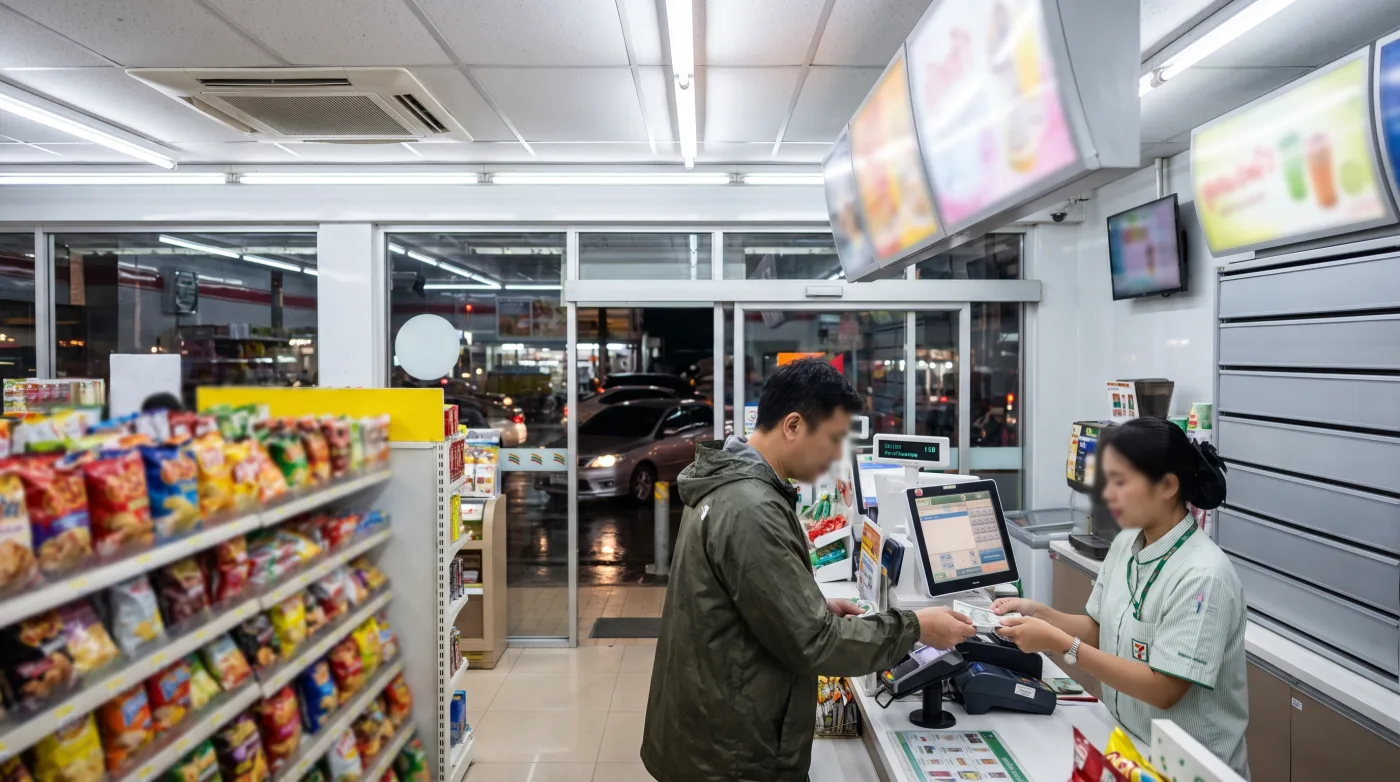
7-Eleven, airport counter or carrier shop each trade price against convenience. Know which before you land.
The airport kiosks at Suvarnabhumi (gates 5-7 in the arrivals hall) and Don Mueang (ground floor, just past arrivals) are the fastest option. Prices run slightly higher than the city, usually by 50 to 100 baht for the same tourist package. You pay the convenience premium for a SIM that is activated, registered, and inserted before you reach the taxi stand.
7-Eleven sells the same tourist SIMs at the standard carrier price. There are over 7,000 7-Eleven stores across Thailand and dense coverage on every Sukhumvit soi. The cashier can register and activate the SIM at the counter using their own scanner. If you can wait until you reach the hotel, this is the cheapest path to the same product.
Family Mart and the smaller convenience chains carry the same SIMs, same price, same registration flow.
Mall electronics counters inside Terminal 21, EmQuartier, Central Embassy, Siam Paragon, and MBK all carry tourist and prepaid SIMs. Staff are usually English-fluent and can help with phone settings.
Official carrier shops (AIS, dtac, TrueMove H) inside any major mall are the right choice if you need a SIM swap, a number port, a long-term postpaid contract, or English-speaking technical support. Shop locator apps from each carrier list every branch in Bangkok.
eSIM Options: Skip the Queue Entirely
An eSIM activates before you land, so you walk out of the airport already connected.
If your phone supports eSIM (every iPhone XS and later, every Pixel 3 and later, most flagship Androids from 2020 onward), you can land with mobile data already active.
Airalo sells Thailand eSIM packages from $4.50 for 1 GB / 7 days up to $26 for 20 GB / 30 days. You buy in the app before you fly, scan a QR code, and the eSIM installs in minutes.
Holafly offers unlimited data eSIMs from around $19 for 5 days. The unlimited model is the right pick if you stream a lot or tether a laptop heavily.
Yesim is the budget alternative with similar coverage and slightly lower prices than Holafly for unlimited tiers.
Trade-off: eSIMs from these providers route through international roaming partners, so you do not get a Thai phone number. For bookings on Agoda, Grab, Bolt, LINE Man, or a Thai bank app that wants SMS verification, a physical Thai SIM still wins.
Long-Term Postpaid: For Residents
If Bangkok is the new address, you graduate to a postpaid plan once you have either a Thai work permit or a lease of 3 months or longer (some carriers accept just the lease, others require both).
Monthly postpaid plans run 400 to 1,500 baht. The middle tier around 700 to 900 baht typically includes unlimited 5G data, unlimited domestic calls, and a small international call allowance. The top tier adds device discounts and faster priority data after the soft cap.
Walk into any AIS, dtac, or TrueMove H shop with passport, work permit or lease, and a Thai bank account or credit card for the monthly direct debit. The signup takes 30 to 45 minutes.
Topping Up: Four Easy Paths
Whether prepaid tourist or long-term, top-ups are simple.
- 7-Eleven and Family Mart: tell the cashier your number, hand over cash, receive a printed receipt with the top-up code.
- Carrier app (myAIS, dtac, TrueiService): add a credit card once, top up in 10 seconds after.
- USSD code: dial the on-pack code from your phone, enter a voucher number, balance updates instantly.
- Carrier website: pay by international credit card from anywhere in the world, useful for keeping a number alive between trips.
WiFi Calling and 5G Coverage
All three Thai carriers support WiFi Calling on iPhones and most Android flagships. Switch it on in your phone settings and incoming calls route through any WiFi network when cell signal is weak, which matters in basement parking, deep elevators, and a few older condo towers.
5G is dense across central Bangkok on every carrier. Sukhumvit, Silom, Sathorn, Ratchada, Phra Nakhon, and the riverside all carry full 5G coverage in 2026. Outer suburbs and the longer elevated BTS sections fall back to 4G LTE, which still handles video calls and full HD streaming without issue.
Which Carrier to Pick by Neighborhood
If you are staying in Sukhumvit (Asoke, Phrom Phong, Thonglor, Ekkamai): AIS for the strongest indoor signal in the high-rise condo and mall density.
If you are staying in Khaosan or Phra Nakhon: dtac or TrueMove H both perform well here. The price-led pick is dtac.
If you are traveling around Thailand (islands, north, beach hops): TrueMove H. The coastal and rural footprint is the most consistent of the three.
If you are an arriving expat moving in long-term: AIS postpaid in central Bangkok. The signal advantage compounds over months of daily use.
Pick the SIM that matches the trip, register the passport once, and the rest of Bangkok opens up.
FAQ
Which Thai carrier is best for Bangkok? AIS leads on overall Bangkok 5G coverage and indoor signal in malls and condos. TrueMove H is the strongest pick if you also plan to travel south to the islands. dtac suits travelers who want the cheapest unlimited tourist data and stay mostly in central Bangkok.
Is an eSIM or a physical Thai SIM better? An eSIM from Airalo, Holafly, or Yesim is faster on arrival and works the moment you land. A physical SIM from AIS, dtac, or TrueMove H is cheaper for stays over 8 days and gives you a real Thai phone number for bookings, banking, and ride-hailing apps.
Can I top up my Thai SIM card online? Yes. Every Thai carrier supports top-ups through their own app (myAIS, dtac, TrueiService), through their website with a credit card, by USSD code, or by buying a top-up card at any 7-Eleven or Family Mart in Bangkok.
Do I need my passport to buy a Thai SIM card? Yes. Thai law has required passport registration for every prepaid SIM since 2014. Bring your physical passport to any airport kiosk, 7-Eleven, or carrier shop. A photo of the passport on your phone is not accepted.
Is 5G available everywhere in Bangkok? 5G covers central Bangkok densely across all three carriers, including Sukhumvit, Silom, Sathorn, Ratchada, and the riverside. Coverage thins in outer suburbs and on some elevated BTS sections, where the network falls back to 4G LTE at speeds that still handle video calls and streaming.
New to Bangkok? Pick up your SIM at the airport, then jump to the Suvarnabhumi to Bangkok guide or the Don Mueang to Bangkok guide for the ride into the city. Pair with where to exchange money in Bangkok to handle currency next, and browse business services on BGM for any other arrival-day essentials.