First Time in Bangkok: Your First 48 Hours, Sorted
First time in Bangkok? Here is the calm 48-hour playbook: airport to city, money, SIM, BTS and MRT, taxis, and where to base yourself.
The doors of Suvarnabhumi slide open and the warm air hits before the noise does. Trolleys squeak across polished marble, taxi dispatchers wave clipboards, a 7-Eleven hums to your left. You are first time in Bangkok, you have a passport, a phone on 4 percent, and a vague hotel address. This guide walks you through the next 48 hours with calm, in order, the way a local friend would.
You do not need to hack the city. You need to make four small decisions well: how to reach your hotel, where to change money, which SIM to buy, and how the trains work. Do those four right and the rest of Bangkok opens up.
Getting from the airport to the city
Bangkok has two airports, and the route depends on which one you land at.
Suvarnabhumi (BKK). The Airport Rail Link sits one level below arrivals and runs straight to Phaya Thai BTS in about 26 minutes for roughly 45 baht. (Full breakdown in our Suvarnabhumi to Bangkok guide.) Service runs from around 5:30 a.m. to midnight. From Phaya Thai you transfer to the BTS Sukhumvit Line, which gets you to Asoke, Phrom Phong and Thonglor without a taxi. This is the easiest first move if your bags are light and your hotel sits near a BTS station.
If you have heavy luggage, late-night arrival, or a hotel away from rail, use Grab. Open the app at arrivals, request a ride from the official Grab pickup zone on level 2 (the signage is clear), and pay through the app. A central-Bangkok ride runs roughly 400 to 600 baht depending on traffic and time of day. The metered public taxi queue on level 1 is also fine if the driver agrees to use the meter, which they almost always do when you join from the official airport queue.
Don Mueang (DMK). The budget-airline airport has no Airport Rail Link. Use the SRT Red Line train from the airport into Krung Thep Aphiwat station for about 33 baht, or take Bus 138 toward central Bangkok for around 30 baht. (Full breakdown in our Don Mueang to Bangkok guide.) Grab works the same way here, with pickup at the second-floor curb. A central ride from Don Mueang runs roughly 300 to 500 baht.
One detail worth knowing on day one: hotel airport shuttles in Bangkok are real, but most run on a fixed schedule and only between certain hotel-chain properties. Confirm by email the day before. If the shuttle is unclear, Grab is the safer pick.
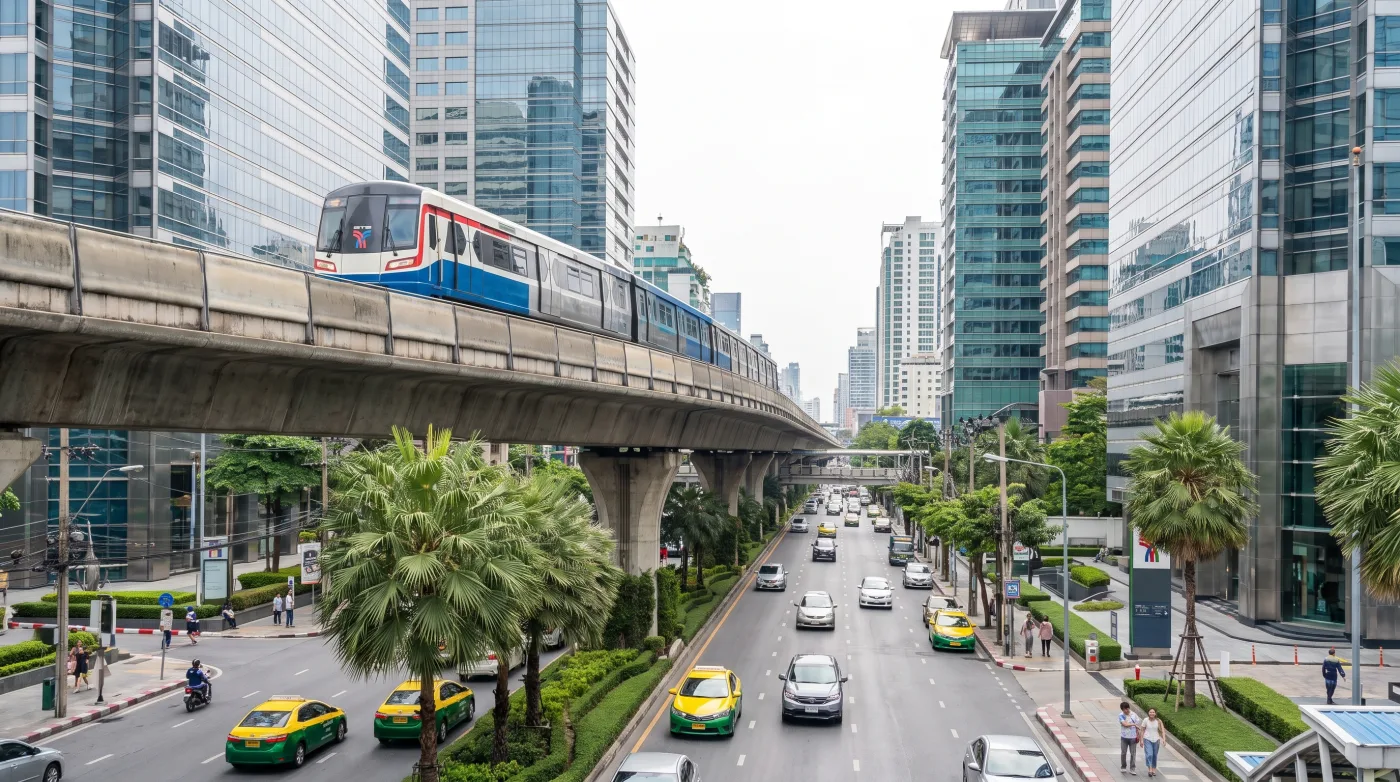
The BTS Skytrain is the single fastest way to make Bangkok feel small. Learn three lines and the city opens up.
Changing money in Bangkok
Full breakdown in our where to exchange money in Bangkok guide. The short version:
ATMs at the airport work fine, but the per-transaction fee on foreign cards is around 220 baht, and the rate is average. Withdraw only what you need for the first 24 hours, then change cash properly in town.
For the best rates, head to a SuperRich Thailand branch. Their orange-and-green storefronts sit near Asoke (just outside BTS Asoke), Pratunam (next to the markets) and Silom. Bring your passport for any exchange above a few thousand baht. Vasu Exchange on Sukhumvit Soi 7/1 is a long-running alternative with similar rates and shorter queues at peak hours.
A rough mental anchor for budgeting: at the time of writing, 1 US dollar trades for around 36 baht and 1 euro for around 39 baht. These are approximate, so check live rates before you change a large amount. A bowl of noodles at a street stall costs 60 to 90 baht. A long Grab across town costs 200 to 350 baht. A cocktail in Thonglor runs 400 to 600 baht. Knowing the noodle-to-cocktail spread tells you how Bangkok prices feel.
Carry small bills. A 1,000-baht note is rarely useful for street food, and motorbike taxi drivers prefer 20s, 50s and 100s.
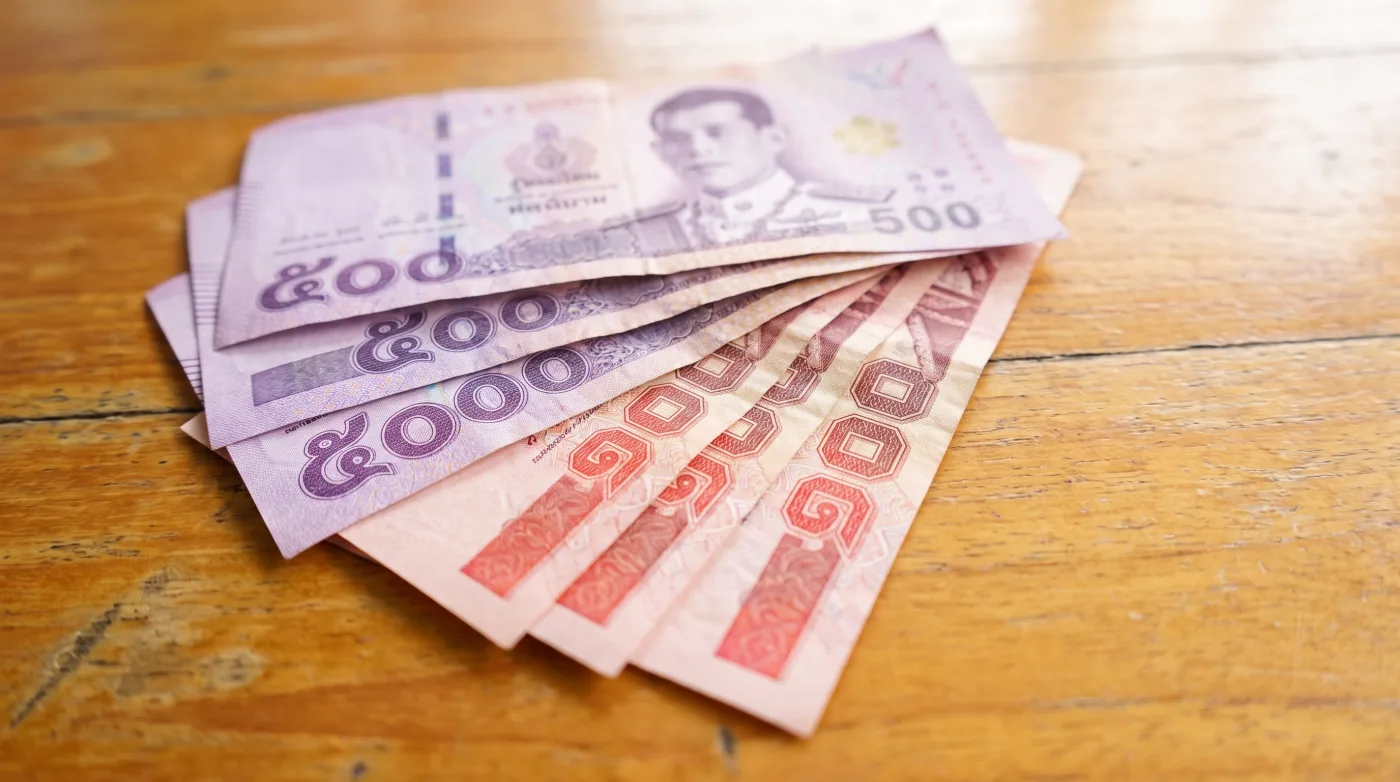
Skip the airport money changers for anything beyond a taxi fare. SuperRich and Vasu beat them on rate every time.
Buying a SIM card on arrival
Full breakdown in our Thai SIM card in Bangkok guide. The short version:
Three networks dominate Thailand: AIS, dtac and TrueMove H. All three have kiosks at Suvarnabhumi and Don Mueang arrivals. The tourist plans are the easy buy.
A typical 8-day unlimited-data tourist SIM runs about 299 baht. A 15-day plan with more data and minutes runs 499 to 599 baht. Coverage in central Bangkok is excellent on all three, and AIS edges ahead in rural Thailand if you plan to travel onward.
Bring your passport. Thai law requires registration for any prepaid SIM, and the staff at the kiosk handle it for you in two minutes. Ask for a nano-SIM and confirm the eSIM option if your phone supports it, since most flagship phones (iPhone 14 and later, recent Pixel and Samsung models) install instantly with a QR code.
If you have a global eSIM provider already (Airalo, Holafly, Nomad), it works for the first day, but a local SIM gives you a Thai phone number, which Grab, food-delivery apps and hotel staff occasionally need.
Riding the BTS, MRT, and Airport Rail Link
For the full station map, fares, and interchange detail see our Bangkok BTS MRT guide. The short version:
Bangkok's rail system is the unlock. Once you understand three lines, the city stops feeling chaotic.
BTS Sukhumvit Line. The light-green line. Runs along Sukhumvit Road through Asoke, Phrom Phong, Thonglor, Ekkamai. This is the spine of expat Bangkok.
BTS Silom Line. The dark-green line. Connects Siam to Saphan Taksin on the river, with stops at Sala Daeng (for Silom nightlife) and Chong Nonsi.
MRT Blue Line. The underground. Loops from the river through Hua Lamphong, Sam Yan, Silom, Sukhumvit, Phetchaburi, Phahon Yothin. Useful for reaching Chinatown and the new Wat Mangkon station, which puts you a five-minute walk from the temples.
For payment, the BTS uses a single-journey ticket (16 to 62 baht depending on distance) or the Rabbit Card, a stored-value card you load at any station counter for 200 baht (100 baht is the card, 100 baht is initial credit). The MRT uses its own MRT Card, single-journey tokens, or, increasingly, a contactless Visa or Mastercard tap directly at the gate. Pick up a Rabbit Card on day one for the BTS and tap your bank card on the MRT. That covers 90 percent of your transit needs.
A practical note: the BTS and MRT do not share a single card yet, so plan to carry both. Trains run roughly 6 a.m. to midnight on both systems.
Grab, taxi, motorbike taxi
For everything off the rail map, three options.
Grab is the default. The app shows the price upfront, the route is GPS-tracked, and payment can be cash or linked card. A 5-kilometer ride in central Bangkok runs 100 to 180 baht. Use the GrabCar option for air-conditioned cars, GrabTaxi if you want a metered green-and-yellow cab through the app.
Metered taxi off the street works when the driver agrees to use the meter ("meter, please"). At the airport, use the official queue on level 1. In town, look for cabs with the red TAXI-METER light glowing on the dash and flag one moving (rather than parked). Fares start at 35 baht and a typical central-Bangkok trip lands at 80 to 200 baht.
Motorbike taxi is the last-mile solution. The drivers wear orange vests and cluster at corners and BTS exits. A short hop down a soi runs 20 to 60 baht. Agree the price before you sit, take the helmet, hold the back rail, and lean with the bike on corners. For longer crosstown trips, Grab or the BTS wins.
Mid-trip checkpoint: once you have picked a neighborhood for your first night, browse BGM's restaurant catalog for that area to lock in dinner.
Where to base yourself for the first 48 hours
For the full neighborhood breakdown, see our where to stay in Bangkok guide. The short version:
Bangkok is a city of neighborhoods, and your hotel choice shapes the trip more than the hotel itself.
Sukhumvit, Asoke to Phrom Phong is the first-time default. You get BTS Sukhumvit Line, MRT Blue Line interchange at Asoke, dense walkable food, EmQuartier and Terminal 21 malls, and easy late-night transit. If this is your first trip, pick a hotel within ten minutes of Asoke, Phrom Phong or Thonglor BTS.
Sathon and Silom suit a business or shorter trip. Sathon has the CBD energy, embassies, and high-end hotels. Silom flips at night into nightlife and food markets. The BTS Silom Line and MRT Blue Line both run through, and the Saphan Taksin station puts you at the Chao Phraya ferry pier.
Phra Nakhon is the old royal core, home to the Grand Palace, Wat Pho, and Khao San Road's reinvented food street. Stay here if temples and cultural Bangkok are the main reason for your trip. The MRT Blue Line extension has made Phra Nakhon much easier to reach.
Charoen Krung, around Bang Rak is the art-and-river angle. The Creative District stretches from the General Post Office down through the warehouses now hosting galleries, design studios and the Mandarin Oriental's neighborhood. Walkable, low-rise, photogenic at dusk.
Whichever you pick, the rule is the same: walk ten minutes from your hotel on the first evening and eat at the busiest place you see with a Thai-language queue.
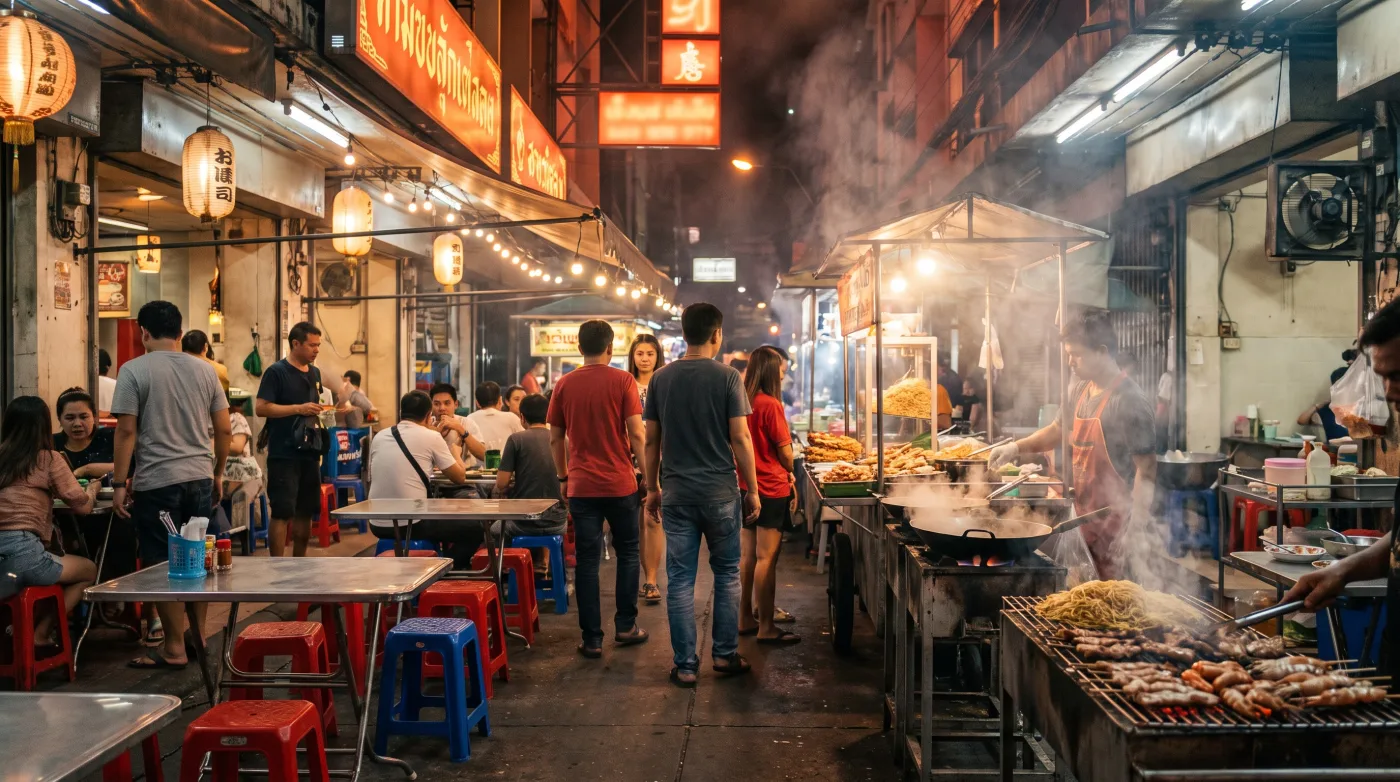
Sukhumvit between Asoke and Phrom Phong, the default first-time base. BTS, MRT, and dinner all within ten minutes on foot.
The first-night practical: eat near where you sleep
Bangkok rewards proximity on night one. Jet lag will hit by 9 p.m. and a 40-minute taxi back from a destination restaurant is the wrong move.
If you are based in Sukhumvit, head straight to the side-soi food off Asoke (Sukhumvit Soi 23 has a strong dinner cluster) or to the Phrom Phong street stalls around Soi 38's reincarnation along Soi 39. If you are in Silom, walk to the Silom 4 and Convent Road food street the moment it sets up around 6 p.m. If you are in Phra Nakhon, the Khao San night market and Phra Athit Road both feed you well within a ten-minute walk. If you are on Charoen Krung, the lanes around Talat Noi and the OneEightyTwo food cluster handle dinner.
For the Grand Palace and the temples, go directly to the official entrance on Na Phra Lan Road and buy your ticket at the official counter. Use Grab or the MRT to Sanam Chai station, then walk in.
For Asoke and Nana at night, use BTS to Asoke and walk to your chosen restaurant or bar. The neighborhood is well-lit, busy, and easy to navigate on foot.
Your day-one checklist
By the end of day one, four things should be done:
- Cash and SIM in hand. Tourist SIM at the airport kiosk, then 5,000 to 10,000 baht changed at SuperRich or Vasu within the first 24 hours.
- Rabbit Card loaded. 200 baht at any BTS counter. Tap your contactless bank card on the MRT.
- Hotel-to-BTS walking route memorized. Walk it once in daylight so you know it after dark.
- First dinner booked or scouted. A spot within ten minutes of your hotel, full of locals, ordered by pointing if needed.
Do those four and Bangkok stops being a maze. Day two is then yours to spend on what you actually came for: the temples, the food halls, the rooftops, the markets, the river ferries.
FAQ
What is the cheapest way to get from Suvarnabhumi to central Bangkok? The Airport Rail Link from Suvarnabhumi to Phaya Thai costs about 45 baht and takes roughly 26 minutes. Trains run from early morning to around midnight and connect to BTS at Phaya Thai.
Where do I get the best exchange rate in Bangkok? SuperRich Thailand branches near Asoke, Pratunam and Silom typically offer the best rates in central Bangkok. Vasu Exchange in Sukhumvit Soi 7/1 is a long-running alternative. Bring your passport for any exchange above small amounts.
Which SIM card should I buy on arrival? AIS, dtac and TrueMove H all sell tourist SIMs at the Suvarnabhumi and Don Mueang arrivals halls. An 8-day or 15-day unlimited-data tourist plan runs roughly 299 to 599 baht. Bring your passport for registration, which is required by Thai law.
Can I use a contactless credit card on the BTS or MRT? The MRT Blue Line accepts contactless Visa and Mastercard at the gates. The BTS still uses single-journey tickets or the Rabbit Card for stored value. Pick up a Rabbit Card at any BTS counter on day one.
Where should a first-time visitor stay in Bangkok? Sukhumvit between Asoke and Phrom Phong is the easiest first-time base, with BTS, MRT and food in walking distance. Sathon and Silom suit business trips, Phra Nakhon suits temple and cultural exploration, and Charoen Krung suits art and riverfront walking.
Now find your first dinner: browse Bangkok restaurants on BGM →