How to Get Around Bangkok: Grab, Taxis, Motorbikes, Tuk-Tuks
How to get around Bangkok like a local: Grab fares, taxi colors, motorbike taxis, tuk-tuks, boats, and the BTS. Practical 2026 guide for new arrivals.
It is 5 PM on Sukhumvit. A pink taxi crawls past you with its red For Hire light on. Three orange-vest motorbike riders rev at the soi mouth. A tuk-tuk driver tilts his chin in your direction. Above your head, the BTS Skytrain rolls past with a soft electric hush. This is the Bangkok choice you make ten times a day, and learning how to get around Bangkok well is the single biggest quality-of-life upgrade for any new arrival.
The good news: every option here is cheap by global standards, mostly safe, and the apps now do the language work for you. Here is the working playbook for 2026, in the order you will actually use them.
Grab: the safe default for new arrivals
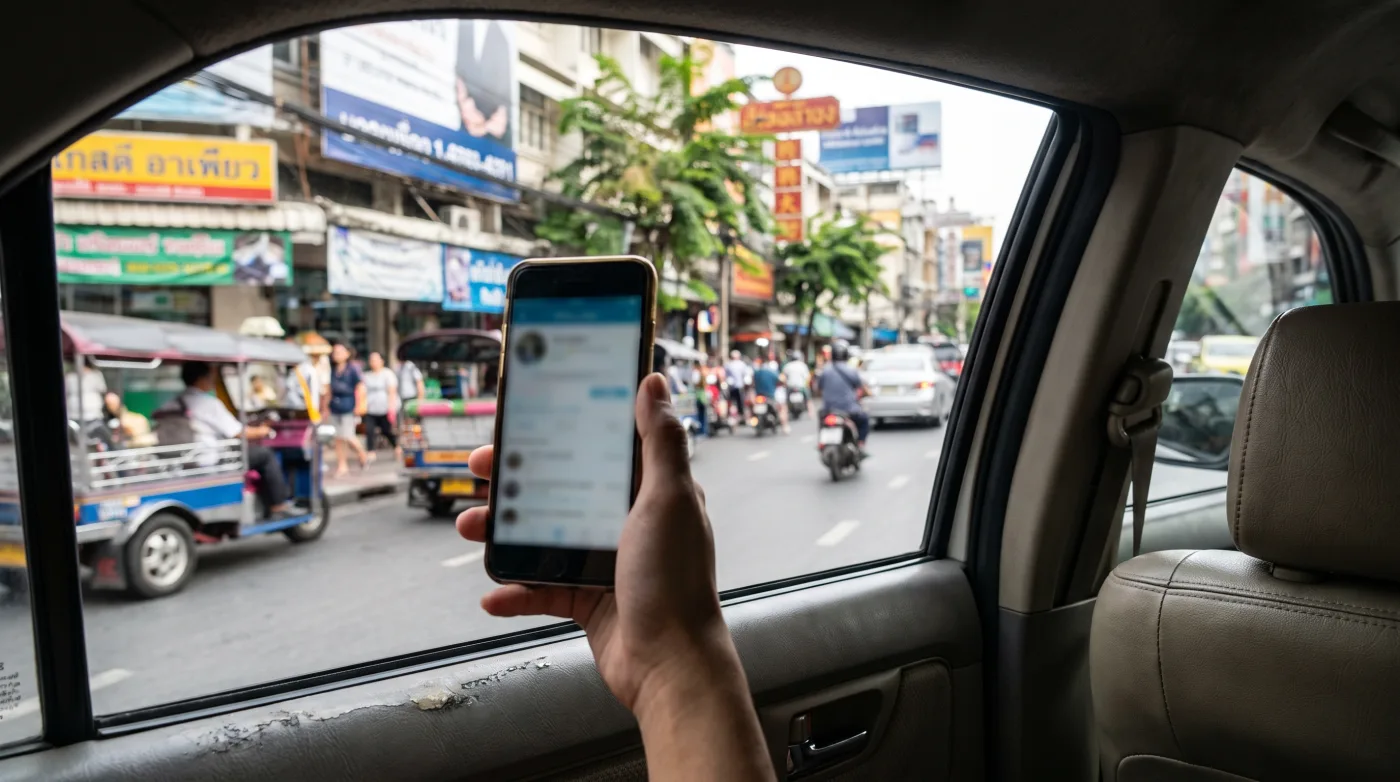
Fixed price shown before you book, no haggling, no meter games. Grab is the safe first-week default.
Download Grab before your flight lands. The app dominates Southeast Asia and runs the same way it does in Singapore, Manila, or Ho Chi Minh City. You enter a pickup pin and a destination, the app shows the fare upfront, and you pay by linked card or cash at the end.
Three rider tiers cover most of what you need.
GrabCar is a private sedan, the most comfortable choice and the one to default to with luggage, in the rain, or after a late dinner. Typical fare across central Bangkok runs 80 to 200 baht, with Suvarnabhumi runs landing closer to 350 to 450 baht.
GrabBike is a motorbike, helmet included, your driver in an orange-and-green jacket. Short hops cost 40 to 90 baht and beat traffic decisively at rush hour. Good for one person, no large bag.
GrabTaxi is the same metered pink-or-yellow car you would flag on the street, dispatched through the app. The fare is metered, plus a small booking fee. Useful when no GrabCar is nearby.
Browse Bangkok neighborhoods on BGM and the app will quote door-to-door pricing the moment you pin an address.
Bolt and InDrive: the value alternatives
Bolt operates the same way as Grab and often quotes 10 to 20 percent cheaper for the same route, especially off-peak. Coverage is thinner in Bangkok than Grab, so you may wait a few minutes longer for a driver. Worth installing as a backup.
InDrive flips the model: you propose a fare, drivers accept or counter. It rewards riders who know roughly what the route should cost, which is to say, riders who have lived in Bangkok for a couple of months. New arrivals are usually better served by Grab or Bolt for the first few weeks.
Public metered taxis: the street option
Bangkok taxis come in pink, yellow-and-green, green-and-yellow, blue, orange, and white-and-purple liveries. The colour codes the owner cooperative, nothing about the service level. All of them are metered, all of them start at 35 baht, and all of them are required by law to run the meter when carrying a passenger.
Two phrases unlock the system. Mid-ter krap if you are male, mid-ter ka if you are female, meaning meter please. Say it before you sit down, after you have told the driver your destination. Most drivers will smile and flip the meter without a word.
Cash only. Keep 100-baht notes ready. A typical Asoke-to-Silom hop runs 70 to 100 baht. Add 50 baht for tolls if your driver takes the expressway, which is often the right call in heavy traffic.
Browse practical Bangkok arrival guides on BGM →
Motorbike taxis: the last-kilometre win
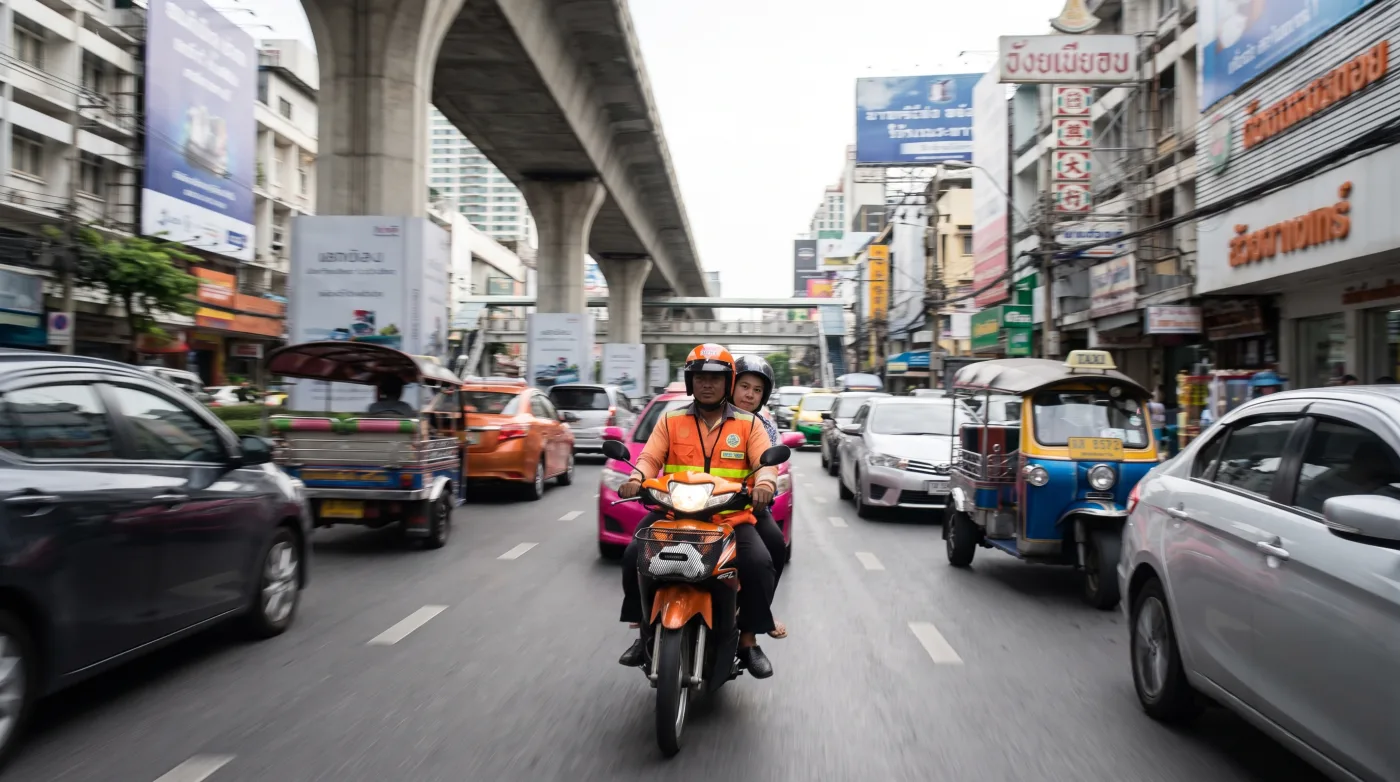
Orange vests beat gridlock on the last kilometre. Fast, cheap, not for the nervous.
The orange-vest motorbike taxi is the most Bangkok-specific transport on this list. Every BTS station, every major soi mouth, every busy intersection has a cluster of riders waiting on a numbered bench. They cover short distances at a fixed price the cooperative sets per district.
A two-kilometre hop is typically 20 to 50 baht. The longer end of usefulness is around six kilometres for 80 to 100 baht. The rider hands you a helmet before you sit, which is required by Thai law and the only correct way to ride.
Use them for the part Grab solves badly: the last kilometre from a BTS station into a quiet soi, when you are running ten minutes late and the road is solid red on the traffic map. Tell the rider your soi number, point on a map if needed, sit upright with your bag in front, and you will arrive faster than any car in the city.
Tuk-tuks: ride them for the experience
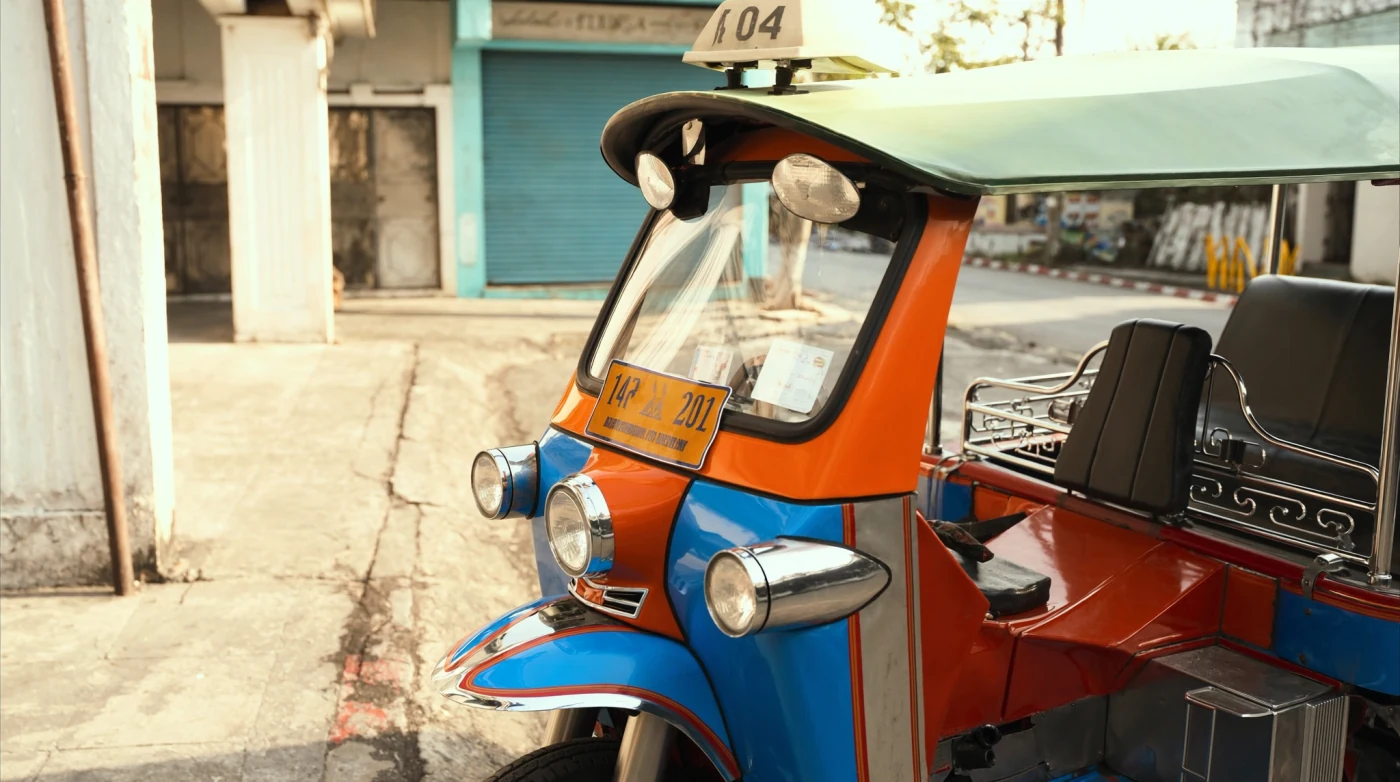
Agree the price before you sit down. Short hops are the fun ones.
The three-wheeled tuk-tuk is part of the Bangkok story and worth riding once. The honest framing: as daily transport, Grab gives you better pricing and a roof. As a fifteen-minute loop around the old town with the wind in your face, a tuk-tuk delivers something no app can.
Negotiate the fare before you sit down. A short loop in the Khao San or Grand Palace area runs 60 to 150 baht for two passengers. Confirm the destination by pointing at a map. For tourists who want predictable pricing, Grab is the cleaner call. For a one-off Bangkok memory in Phra Nakhon, take a tuk-tuk from Wat Pho to Khao San at dusk and call it part of the trip.
Songthaews: the local commuter ride
The red converted-pickup-truck songthaew runs fixed loop routes mostly outside central Bangkok. You will see them in Lat Phrao, Bang Khen, On Nut beyond the BTS, and most of the suburban districts. Flag one going your direction, hop in the back, press the buzzer when you want to stop, pay 8 to 15 baht to the driver through the front window.
Useful when you have rented an apartment in a non-central neighborhood and the BTS does not quite reach. Less useful for first-week travelers staying in Sukhumvit or Silom.
Chao Phraya boats: the cooler way to the old town
The river is a working highway and the cheapest way to reach Wat Pho, the Grand Palace, Wat Arun, ICONSIAM, and Asiatique. Three boat types cover most needs.
The orange flag local boat costs 15 baht flat, runs every 10 to 20 minutes between Nonthaburi and Wat Rajsingkorn, and is what residents take. The blue flag tourist boat is 60 baht single or 200 baht for an all-day hop-on hop-off pass, with English announcements at every pier. The cross-river ferry is 5 baht and shuttles you from Tha Tien to Wat Arun in three minutes.
For a hot afternoon, the river breeze and the temple skyline make this the most enjoyable forty baht you will spend in Bangkok.
Traffic patterns: when to take the train
Two windows define Bangkok road traffic. Morning rush runs 7 to 9 AM, evening rush runs 5 to 7 PM. Add Saturday late-evening Sukhumvit, when the dining and nightlife crowd hits the same six lanes at once. The BTS Skytrain and the MRT subway sail above and below all of it on a fixed schedule.
A Rabbit Card for the BTS and an MRT stored-value card cover both systems and remove the ticket-machine queue. Get them on day one at any station counter. Sunday morning before 10 AM is the calmest the city ever drives, the right window for a long Grab ride to a market on the edge of town.
How a typical Bangkok day actually mixes modes
Here is the working pattern for most expats once they settle in. BTS or MRT for the long leg across the city, because the trains beat traffic at every hour. Motorbike taxi or a short walk for the last kilometre from the station to a specific soi address. Grab for groups of three or four, for rainy days, for late nights past midnight when the trains stop, and for the airport runs.
Cash for tuk-tuks, motorbike taxis, public taxis, songthaews, and boats. Card on the Grab app for everything else. One Rabbit Card in your wallet. One Thai address phrase memorised by day three.
Land in Bangkok with this in your pocket
Three moves before you arrive. Download Grab and link a card. Bookmark the airport-to-Bangkok guides on BGM for Suvarnabhumi and Don Mueang. Save your hotel address in Thai script in your notes, so a taxi driver can read it without the language gap.
One Thai phrase to learn by day three: Pai [destination] krap/ka, meaning go to [destination] please. The whole city opens up after that.
For the trains specifically, see our full Bangkok BTS MRT guide. To see every approved Bangkok transport listing, browse the travel category on BGM or open the venue map.
FAQ
Is Grab cheaper than a taxi in Bangkok? Metered taxis are usually a little cheaper for the same route, often by 20 to 40 baht. Grab wins on transparency: you see the fare before you book, pay by card, and bypass the meter conversation. For most new arrivals, that predictability is worth the small premium.
Are motorbike taxis safe in Bangkok? The orange-vest motorbike taxi network is regulated, helmets are provided by law, and short hops from a BTS station into a soi are how most Bangkok residents finish the last kilometre. Sit upright, keep your bag in front, and tell the rider your soi number before getting on.
How much should a tuk-tuk cost in Bangkok? Tuk-tuks negotiate before boarding. A short hop in the Khao San or Phra Nakhon area is typically 60 to 150 baht. For predictable city pricing, use Grab. Save tuk-tuks for the experience itself, especially a short loop around the old town.
What is the fastest way to cross Bangkok at 6 PM? The BTS Skytrain and MRT subway. Both run above or below traffic and stay on schedule during the 5 to 7 PM rush. Pair a train ride with a motorbike taxi or a short walk for the last kilometre to your address.
Do Bangkok taxis take credit cards? Most street taxis accept cash only. Grab, Bolt, and InDrive accept linked cards through the app. Keep 200 to 500 baht in small notes for taxis, tuk-tuks, motorbike taxis, and boats.